Loading…
80486
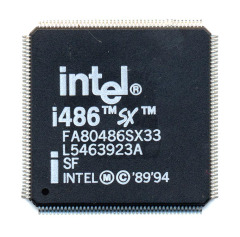
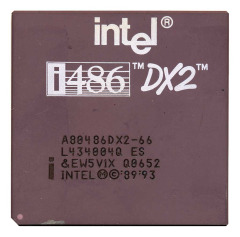
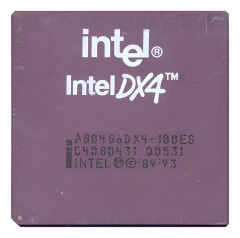
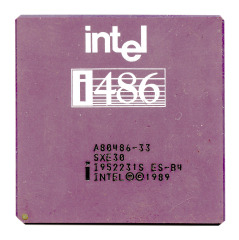
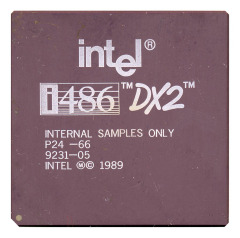
Launched in 1989The Intel 80486 is a fourth-generation x86 microprocessor introduced in 1989 that refined the IA-32 architecture into a far more integrated and efficient design by combining the 80386’s 32-bit programming model, 4 GiB address space, protected mode, paging, and virtual 8086 support with a substantially improved microarchitecture centered on a classic five-stage pipeline, an on-chip unified L1 cache, and in most variants an integrated floating-point unit. Unlike the 80386, whose performance still depended heavily on external memory and discrete coprocessor support, the 486 brought much lower latency and higher instruction throughput through tighter internal integration, single-cycle execution for many simple integer operations, and a cache-coherent burst-oriented bus interface better suited to high-performance systems. The family spans several important variants, including the original 486DX with on-die FPU, the cost-reduced 486SX with the FPU disabled or absent, the 486DX2 with internal clock doubling, and later DX4-class parts using clock tripling and write-back cache enhancements, while preserving full backward compatibility with earlier x86 software. Architecturally, the 80486 does not radically change the ISA relative to the 80386, but it is the processor that transformed IA-32 from a powerful but relatively slow 32-bit architecture into a highly competitive mainstream platform, effectively bridging the gap between the early 386 era and the superscalar Pentium generation.